Guest Blog: Susan Manchester

Let’s Meet the Artist!

I’ve known Susan for approximately fifteen years. I used to walk my giant dog, Ty, in Bloor West Village in Toronto. Susan, her late husband Mike, and I would chat whenever I caught them hanging out on their front porch – which was generally any evening that the weather was nice. Susan often painted on the porch and I was fascinated by the free form and colour of her pieces. When Mike passed away early in 2011, Susan found solace in painting. I should also mention she is an incredible poet. The tomes I have of her work are some of my most prized possessions. In my quest to highlight female artists, Susan is a “VIP” guest blogger – creative, engaging, and exuding both genius and warmth. I am a huge fan.
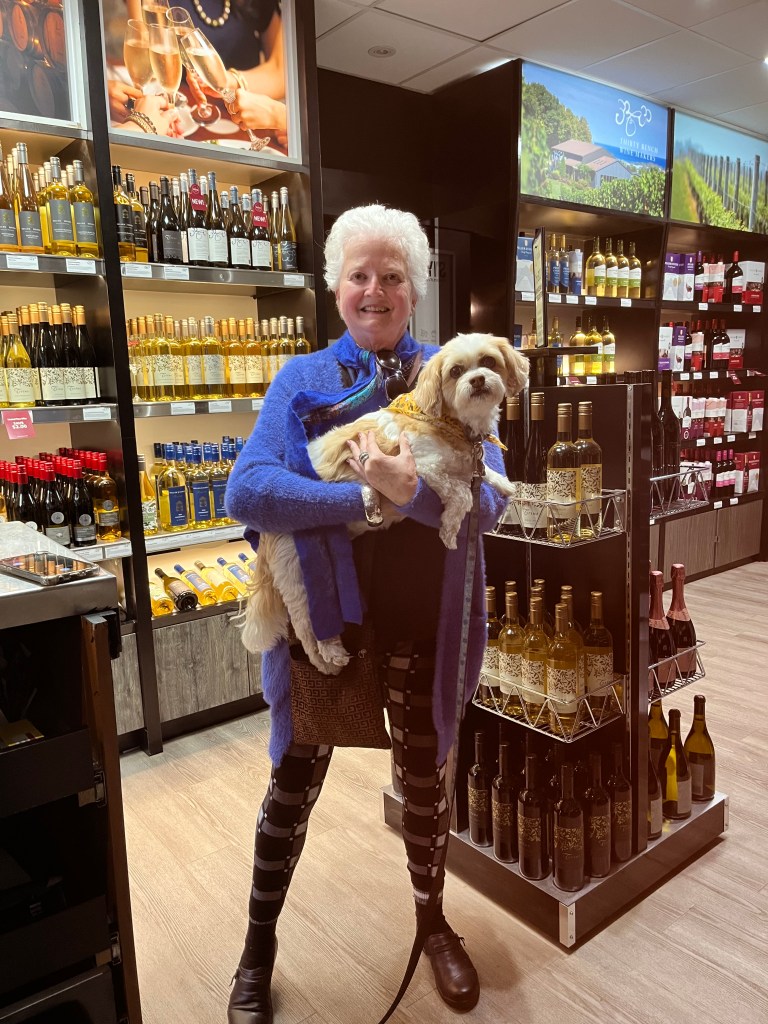
Susan and her studio assistant, Cookie.

Susan, what is your earliest memory?

My earliest memory of doing something artistic may be making potholders on a metal “loom” using nylon loops. Does that count? It is significant to me because I loved the colors then and I still love colors.

What mediums do you use, and do you have a favourite?

I use acrylic paints, tissue paper, Japanese paper, ribbons, lace, fabrics. My favorite is Japanese paper with acrylics.

Mixed media work by Susan Manchester

Tell me about your studio, and how much time you spend in it.

My studio is upstairs in a room that used to be a bedroom. It faces east with a big window so the morning light is wonderful and throughout the day the light is good. I have oodles of Japanese paper: some rolled up and stored in clear plastic compartments that hang on the door; some hanging over dowels on the wall; some in piles on shelves. 

My paints are stored in labeled clear plastic containers on book shelves. I have a large table where I use a table easel for smaller work.  I have a desk where I use the paper cutter and store some materials for making painted greeting cards. A large easel sits in the center of the room for larger work.

I spend an average of 2 to 3 hours a day in my studio in the cold weather. When the weather is warmer I paint outside on the front porch or the back deck.
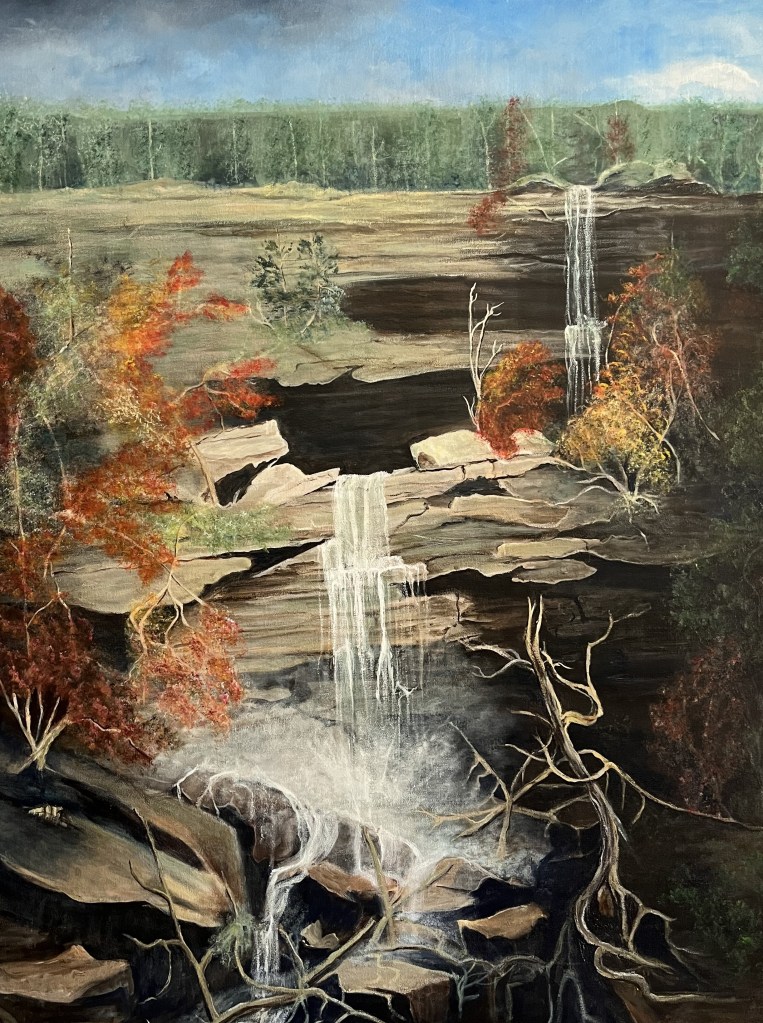
Mixed media work by Susan Manchester

What are some items in your studio that you can’t live without?

In the studio, I can’t live without my little kettle for tea or instant coffee. Haha! And my four Thomas Cole prints that are on the wall above my large table.

We’ve often heard the idea that you have to be a “suffering artist” to make great art. Do you think this is true? Can we make art from a place of great joy and ease?

Yes you can make art from joy and ease! I have done it both ways—after my husband died I was suffering terribly and used my art to paint the grief. And now, 13 years later, I can say I am mostly happy and the art is flowing. That does not mean that I don’t tap into the grief—I do, often. But the energy that comes with the joy of creating allows the art to live vibrantly and meaningfully.

What are the things that challenge you, as an artist?

My main challenge as an artist is to be able to paint more intuitively, especially as I am leaning more towards the abstract. Another challenge is to try to resist the solitary life that can develop when the desire to remain in the sudio is so strong.

Who are the artists that YOU follow? 

I am loving Louise Fletcher and Dorothy Ganek as abstract artists. My first influences were Dali, Van Gogh’s “The Potato Eaters,” and my all time favorite landscape artist Thomas Cole.

What is the best advice you have ever received as an artist?

Best advice: “A tree can be any color.” That came from my teacher Modesto Ingratta, who is still my teacher. That little statement says it all. It is all about freedom, truth, and courage for an artist. There is no end to the learning. Rejoice in that!

Do you have any “Stretch Goals” or ways that you want to express yourself that you haven’t tried yet?

I am always stretching. I may try pastels. Never done that and I have a lovely set.

Where can we find your work?

My work is available on my website: susanmanchester.myfreesites.net
You can see a bit of my process here.

Or follow me on Instagram: susan_manchester and DM me for details.

Guest Blog: Doodle & Flourish Art

Beverley Moorhouse

Let’s Meet Beverley Moorhouse!

Beverley is an intuitive artist working in bold watercolours and inks to weave emotions into every inch of my artwork. Her passions are an unwavering commitment to mental health and the belief everyone should be deeply seen. Through her creations, she creates a unique talking point, inviting you in to discover what all the mark making might mean. Her art helps those feeling ignored, isolated, dismissed and misunderstood to experience belonging, recognition, find acceptance and feel a sense of importance.

Beverley, what is your earliest memory of losing yourself in something artistic? 

I have always been creative. In childhood, I was always making things. I liked nothing more than creating Christmas decorations to hang in my family home.

I love the name of your business, Doodle and Flourish. How did you land on that name?

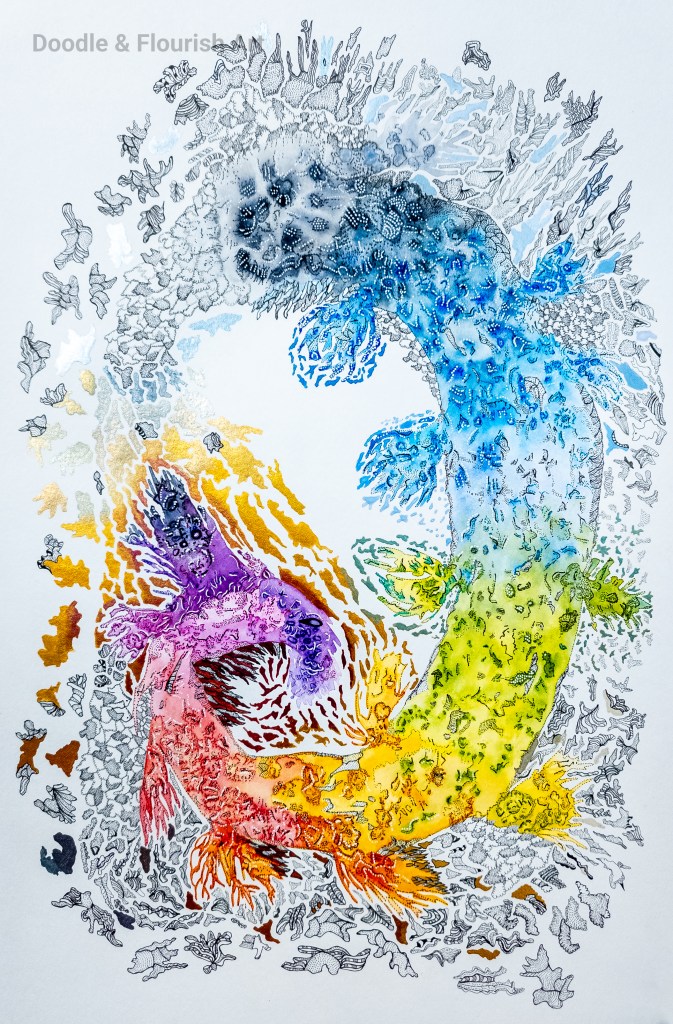
The Imposter Within, by Beverley Moorhouse

I have always loved calligraphy.  It was on my return to creativity later in life that once more, I took up calligraphy. “Flourish” is the decorative curls we see in calligraphy. But “flourish” also means thriving. “Doodle” is all about just putting pen to paper and letting that pen produce a line… seeing where the line travels across the paper.

I have always encouraged people to be creative. “Doodling” doesn’t sound too scary and I think it’s the easiest thing for people who aren’t familiar with art to do. While they are “doodling,” they are accessing their right brain and getting out of their analytical left brain. They are beginning to “flourish” in their creative life.

That’s how Doodle and Flourish was born.

What mediums do you use, and do you have a favourite? 

I use watercolours, inks, acrylic pens and marker pens. I have always loved watercolours because I love how they bleed and bloom on paper. They have a life all of their own and you can’t really control that bleed and bloom, other than removing the water. That says freedom to me. Freedom to move, live and be as creative as you want.

Tell me about your studio, and how much time you spend in it. (If you don’t have a studio, and your art is made on the kitchen table, please talk about how you carve out that space for doing your art).

I don’t technically have a studio! I have a spare bedroom and I create in there. I have a simple desk and a chair, that’s really it. Along with some storage drawers for all the paint, paper and pens.

I don’t calculate the time spent on art. I simply create when the intuition strikes. I create when time with my family and job allows. I think that is the way to be. I can’t imagine setting a schedule to create. I think that puts a fence around intuitively creating. I know if I did that, I would arrive at my desk not knowing what to create or not feeling like it that day. I much prefer to create when my intuitive self is ready. It comes back to that freedom feeling again.

My Spirit Takes Flight, by Beverley Moorhouse

What are some items in your studio that you can’t live without? 

My fineliner pens. Unipin has become a favourite, with Micron pens in second place. Without those, the marks wouldn’t happen.

We’ve often heard the idea that you have to be a “suffering artist” to make great art. Do you think this is true? Can we make art from a place of great joy and ease? 

I think “suffering artist” actually is another term for “starving artist.” Many artists struggle to make a living from their work. I think it’s about finding your purpose and the purpose of your art. Art communicates to the world. As an artist, what are you trying to communicate with your art?

I could communicate better with my audience when I discovered my art purpose. It also felt like I had come home. When I say “my art and I help those feeling ignored, isolated, dismissed and misunderstood to experience belonging, recognition, find acceptance and feel a sense of importance.” That’s the purpose of my art. People start to wonder what my mark making might mean. They open a dialogue and ask questions. It gives me an opportunity to talk about my life, my experiences and how they appear in my art. In turn, I can highlight how I am not the only one to have gone through something. Others have too, perhaps even the people looking at my art. I talk about personal things that appear in my art. I speak about tough feelings and how tough life has been in the past and how tough it is now for everyone. I feel those things should not be swept under the carpet. If my art can get people talking, then I have achieved something.

Bursting Out, by Beverley Moorhouse

What are the things that challenge you, as an artist?

My own mind! I think we all have to deal with impostor syndrome. We all compare ourselves to others. We all think we aren’t good enough. We all have to battle these thoughts. While social media is good for some things, it is bad for others, such as comparison. I am in a group of artists and constantly one of us will go through some form of impostor syndrome. It’s why it’s good to have a supportive community around you as an artist, so in the dark times, they can lift you back up. For everyone to grow and develop, it takes a village and I think it really does for artists.

Who are the artists that YOU follow? 

My favourite artist is Roberta Boffo. These are her words about her art “Art conveys peace and calm, but at the same time it can disrupt the peace and push the viewer outside of their comfort zone, push them away from what is relatable and understandable to question sanity and insanity. Art that isn’t always what it looks like and that pulls the viewers into it wanting to look for more.”

The purpose of her art is similar to mine and I feel that is why I connect strongly to it.

Do you have any stretch goals for your art? Or, what would you like to do next?

Evolution, keep evolving as an artist. When I look back to where I was a year ago with my art, I have moved on. I think it’s so important to keep evolving and developing both as a person and an artist. To keep peeling that “onion” of yourself, layer by layer. I feel many people have no concept of how many layers they have. It’s important to explore ourselves and uncover new things we never knew about ourselves. That’s the same with art. As we uncover hidden parts of ourselves, I believe they appear in our artwork. It is bound to happen because the art came from us, we are bound to be in it.

Because I am so passionate about finding our purpose, I want to connect with other artists and help them find out what drives their art, and why they create. I have no idea yet how I plan to set about doing this, but I know it will happen. In the meantime, I will keep talking about it!

What is the best advice you have ever received as an artist?

Peel back the layers of yourself and your art. Find your purpose and the purpose of your art.

Things I dislike… about art, about creativity.

Artists on social media who put up a photo of a piece of their art and write in the caption:
“30 x 40 acrylic on canvas.” Just what the heck does that say about their art? I want to know about this piece. Why did they create it, what do they feel it conveys to the world, what’s special about it? All of this they could write on, but never do. People aren’t going to connect with the art if you don’t write about it. We need to stir up the feelings of the viewer to get people to connect with our art and its message.

Where can we find your work?

You can find me on Instagram – doodleandflourishart

For Facebook – Doodle and Flourish Art